
The ROI of Regular HVAC Maintenance: How Prevention Saves You Money in the Long Run
Why Collin County Homeowners Who Skip HVAC Tune-Ups Pay More in the End
There is a version of HVAC ownership that most North Texas homeowners know well: ignore the system until something goes wrong, pay for an emergency repair in the middle of a July heat wave, and wonder why the energy bill has been climbing for the past two years. Then there is the version that makes financial sense. At Crow’s Heat and Air, we have been serving homeowners and businesses throughout Collin County and surrounding communities since 1992, a family-owned company built on over 65 years of HVAC expertise across generations. Owner Jason Crow holds his Master Contractors License and has built this company on honest work, fair pricing, and the kind of service that earns lifetime customers rather than one-time calls. We offer maintenance plans specifically designed to keep your system running at peak performance and to prevent the service emergencies that cost significantly more than the maintenance that would have avoided them. Here is the financial case for staying ahead of HVAC problems in our climate.
What a North Texas Summer Actually Does to an Unmaintained System
Collin County summers are not gentle. McKinney, Princeton, Allen, Frisco, and the surrounding communities routinely see extended stretches of 100-degree days that push residential HVAC systems to their operational limits for months at a time. An air conditioning system running continuously in that environment is accumulating wear on every component, and without regular maintenance, that wear is happening without any of the small interventions that would slow it down.
Consider what occurs in a system that goes a full year or more without service:
- Coils accumulate dirt and debris that insulate the refrigerant circuit from the heat exchange process, forcing the compressor to work harder to achieve the same cooling output
- Drain lines partially clog with algae growth that is common in our humid summer conditions, eventually causing water backup that damages ceiling drywall and flooring when it overflows
- Refrigerant levels drift from minor leaks that go undetected until the system can no longer maintain setpoint temperatures
- Capacitors and contactors reach the end of their service life without any warning, then fail on the hottest day of the year when every HVAC company in Collin County is fully booked
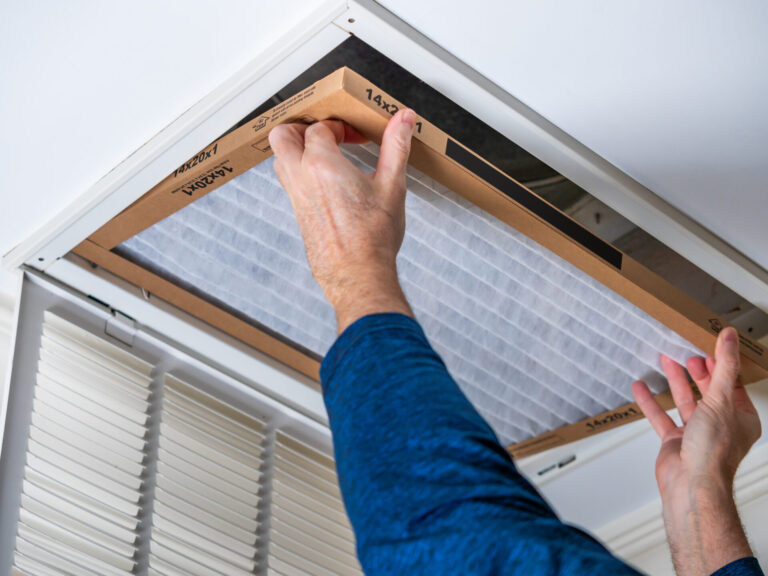
- Air filters become restrictive as they load up with particulates, reducing airflow across the evaporator coil and causing the system to work against itself
Each of these conditions has a cost, and none of them improve on their own. They progress until they either cause a breakdown or generate the kind of chronic inefficiency that shows up quietly but consistently on your monthly utility bill.
The Dollar-by-Dollar Case for Regular Maintenance
The financial argument for regular HVAC maintenance operates on three levels simultaneously: energy savings, repair avoidance, and equipment lifespan.
Energy Savings
An HVAC system running at less than optimal efficiency uses more energy to produce the same conditioning output. Dirty coils, restricted airflow, and low refrigerant are all efficiency killers that inflate your utility bill without producing any additional comfort. In a Collin County home where the air conditioner runs for six or more months of the year, even a modest efficiency loss translates into meaningful additional spend over a full season.
A properly maintained system operates closer to its rated efficiency, which means the energy you are paying for is being converted into cooling rather than being wasted compensating for degraded components. For many homeowners, the annual energy savings alone cover the cost of the maintenance visit.
Repair Avoidance
This is where the financial math becomes most compelling. Preventive maintenance catches developing problems while they are still inexpensive to address. A technician who identifies a capacitor showing signs of wear during a spring tune-up can replace it for a fraction of what an emergency service call costs after it fails on a Saturday evening in August, assuming you can even get a same-day appointment.
The pattern we see repeatedly at Crow’s Heat and Air is that the homeowners who call us for emergency repairs in peak season are almost always the ones who deferred maintenance for one or more years. The homeowners on our maintenance plan rarely call with emergencies, because the conditions that cause emergencies are being identified and addressed before they develop into failures.
Equipment Lifespan
A well-maintained HVAC system lasts longer than a neglected one. The industry standard lifespan for a properly maintained central air conditioning system is 15 to 20 years. Systems that run without regular service typically fall well short of that range, requiring replacement years earlier than they should. In Collin County’s competitive new construction and resale market, an aging or recently replaced HVAC system is a real factor in both your cost of homeownership and your home’s market value.
Extending the life of your existing system by even two to three years through consistent maintenance represents thousands of dollars in deferred replacement cost.
What a Crow’s Heat and Air Maintenance Visit Actually Covers
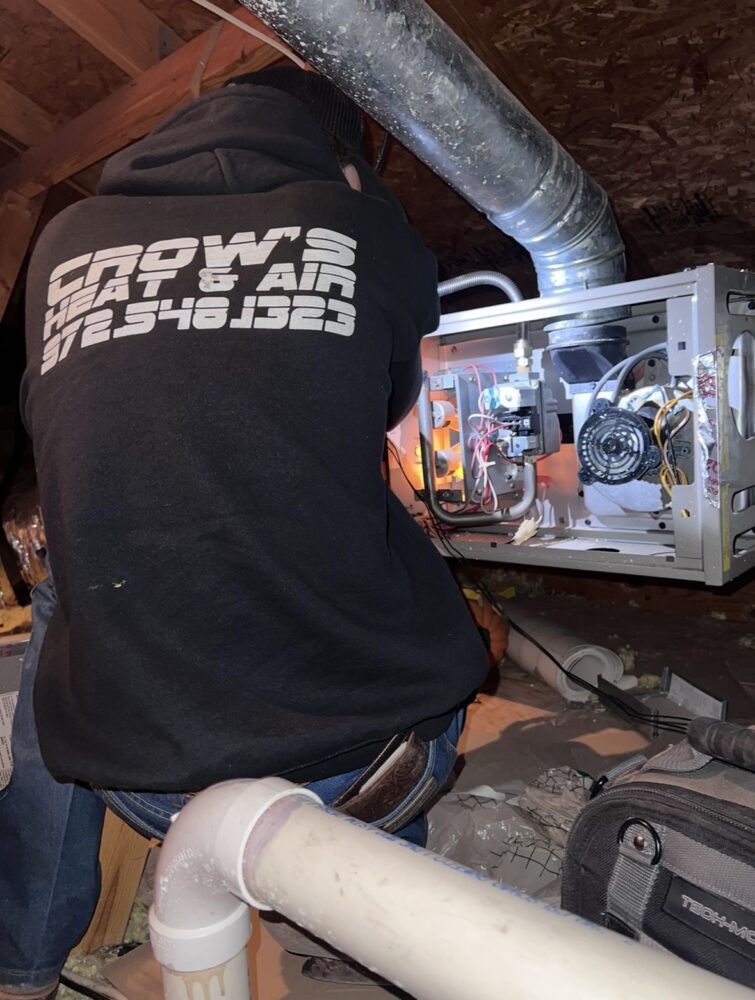
A tune-up from Crow’s Heat and Air is not a technician arriving to change your filter and hand you a bill. It is a comprehensive inspection and service visit that addresses the specific components and conditions that drive HVAC failures and efficiency loss in our climate.
A typical maintenance visit covers:
- Cleaning of evaporator and condenser coils
- Inspection and clearing of condensate drain lines
- Refrigerant level check and leak inspection
- Capacitor and contactor testing
- Electrical connection inspection and tightening
- Thermostat calibration and operation verification
- Blower motor and belt inspection
- Filter inspection and replacement guidance
- Overall system performance evaluation with honest feedback about anything observed
We document our work with photos and provide you with a clear picture of your system’s condition. If something needs attention, we tell you what it is and what it will cost before we do any additional work. No pressure, no surprises, and no recommending repairs your system does not need.
When to Schedule and How Often
For most Collin County homeowners, the ideal maintenance schedule is twice per year: a spring tune-up on the cooling system before peak demand begins in May and June, and a fall tune-up on the heating system before cold weather arrives. This timing ensures both systems are inspected and serviced at the point when they need to perform most reliably.
Crow’s Heat and Air maintenance plans are designed to make this easy and affordable, removing the guesswork about when to call and ensuring your system receives consistent attention year over year. Customers on our maintenance plan also receive priority scheduling, which matters in Collin County when temperatures spike and appointment availability tightens quickly.
Ready to Stop Paying More Than You Have To? Contact Crow’s Heat and Air Today.
Crow’s Heat and Air serves homeowners and businesses throughout Collin County and surrounding communities from our offices in McKinney and Princeton, with honest service, fair pricing, and the kind of HVAC expertise that only comes from over 65 years of family experience. Contact us today to ask about our maintenance plans and get your system on a schedule that protects your comfort and your budget all year long.